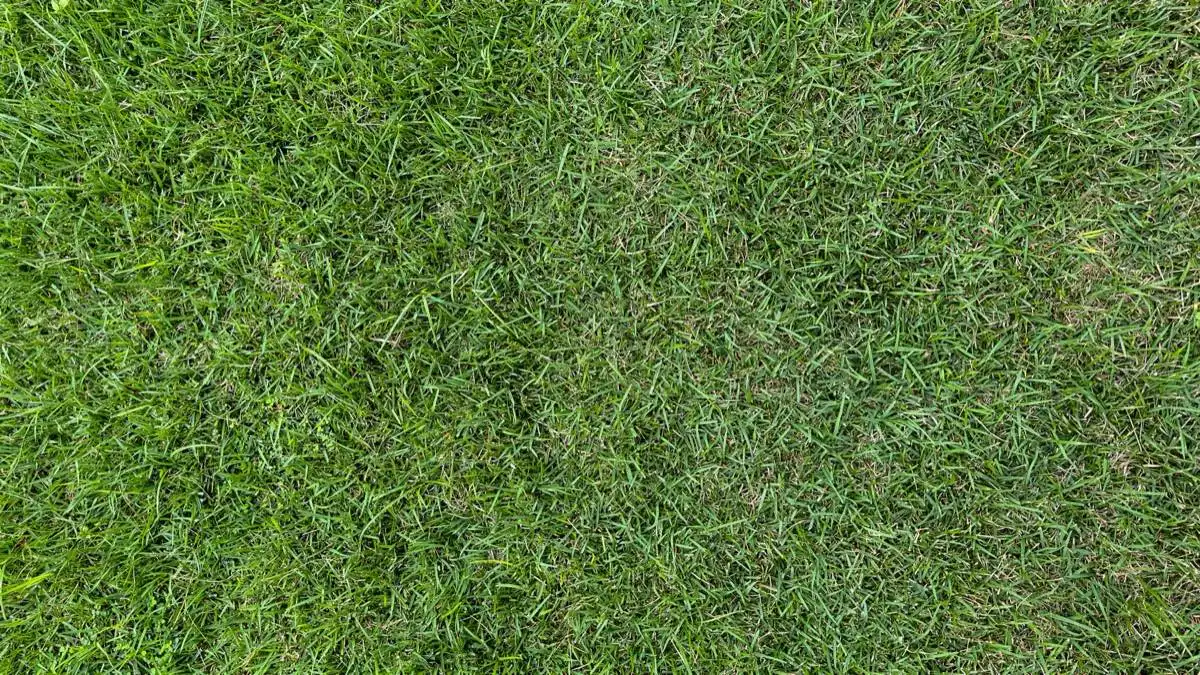
Buffalo grass is the lowest-water lawn grass available, and it is the wrong choice for most yards. It suits full-sun, low-traffic, low-rainfall properties where the goal is a presentable lawn on almost no irrigation. Put it in a busy back yard or a humid climate and it disappoints within two seasons.
It is a native short-grass prairie species, Bouteloua dactyloides, and every one of its virtues and faults comes from that. It survives where other grasses cannot. It does not out-compete them where they can.
The honest ledger
Pros
- Lowest water requirement of any common lawn grass by a wide margin
- Native to the North American plains, so no exotic-species concerns
- Very low fertilizer needs — often none at all
- Mowing every two to three weeks, or never
- Soft, fine texture and a distinctive blue-green color
- Deep roots that reach well below the top few inches
- Excellent heat tolerance
Cons
- Poor traffic tolerance and slow recovery
- Needs full sun, seven hours or more
- Struggles in humid or high-rainfall regions
- Greens up late in spring and goes dormant early in fall
- Thin, open growth habit means weeds get in
- Overwatering actively harms it
- Fewer sod farms grow it, so availability and price vary
The rainfall rule that decides everything
Buffalo grass is a poor choice where annual rainfall runs much above about 30 inches.
This is not about the grass dying. It is about the grass losing. On the short-grass prairie it wins because it survives drought that kills competitors. In a wetter climate, everything else grows faster than it does, and the lawn gradually becomes a collection of whatever else showed up.
If you are in a genuinely dry market and looking at your water bill, buffalo grass is a serious option. If you are somewhere that gets regular summer rain, it is a nice idea that turns into a weed management project.
Water: the actual numbers
Established buffalo grass in a dry climate stays green on roughly half an inch to an inch of water every two to four weeks in summer, and survives on natural rainfall alone in much of its range — it just goes dormant and tan during the driest stretch, then greens back up.
Compare that with the roughly one inch a week that Bermuda wants and the more that St. Augustine wants, and on a 4,000 square foot lawn the seasonal difference is substantial. In markets with tiered water rates or summer restrictions, this is the entire argument for buffalo grass.
The trap is watering it anyway. People install a low-water grass and then run the irrigation system they already had. That produces soft, floppy growth, invites weeds, and eliminates the reason they planted it. If you install buffalo grass, turn the sprinklers down and mean it.
Establishment is the demanding part
Every low-water grass has the same catch: it is only drought tolerant after it is established, and buffalo grass takes longer to get there than most.
Water it on the standard new sod schedule for the first two to three weeks, then taper more gradually than you would with Bermuda. Full drought tolerance arrives over the first full growing season, not in the first month. Getting impatient here is how people conclude the grass "does not work."
Buffalo vs Bermuda
| Buffalo | Bermuda | |
|---|---|---|
| Water once established | Very low | Moderate |
| Sun needed | 7+ hours | 7–8 hours |
| Traffic tolerance | Poor | Excellent |
| Recovery from damage | Slow | Fast |
| Mow frequency | Every 2–3 weeks | Every 5–7 days |
| Fertilizer | Little to none | Regular |
| Weed resistance | Weak, open canopy | Good when dense |
| Cost | Higher, less widely grown | Lower |
| Best climate | Semi-arid, under ~30 in rain | Broad |
Who should plant it
Plant buffalo grass if: you are in a dry or semi-arid market, the area is full sun, foot traffic is light, and you genuinely want to stop watering a lawn. Large rural properties, front yards, and low-use side areas are where it earns its reputation.
Do not plant it if: kids and dogs use the yard, you have any meaningful shade, your climate gets regular summer rain, or you want a dense dark-green carpet. It is a lighter, softer, more open-looking grass, and if you are picturing a golf fairway you will be disappointed on day one.
And here is the part we will say out loud: in a lot of yards the honest answer is not buffalo grass but less grass. If you are drawn to it purely to cut water use, converting the low-use portion of the yard to native beds, decomposed granite, or mulch beats any grass on water and maintenance, and then you put Bermuda on the part you actually walk on. That combination usually costs less to install and less to run than sodding the whole property in anything.
Varieties, since they differ a lot
Improved cultivars are quite different from the wild species and from each other:
- Prestige, Legacy, Density — denser, finer, more turf-like, better color
- 609, Bowie — established improved types, widely grown
- Cody, Bison — selected for cold hardiness
Seeded common buffalo grass and vegetatively propagated improved cultivars are not the same product. If someone quotes "buffalo grass," ask which cultivar and whether it is sod or plugs.
What still matters underneath
Buffalo grass is forgiving about fertility and unforgiving about compaction and drainage. Break the compaction layer four to six inches down, fix the grade so water soaks in rather than running off — the six-inches-in-ten-feet fall from the foundation applies here as anywhere — and skip the heavy compost amendment, because rich soil is not what this grass is looking for. Our yard preparation guide covers the sequence.
Laredo Elite Sod & Turf installs buffalo grass, Bermuda, and other warm-season sod across Laredo and the South Texas borderland, with the soil prep and grading behind it. We will also tell you when the right answer is a smaller lawn rather than a different grass. For how the varieties stack up, see our Bermuda comparison.
Get a free quote → · call (844) 511-2320
Ready for a free quote in Laredo?
Laredo Elite Sod & Turf — free estimate, clear scope, no pressure. Use the form on this page or jump to the homepage quote.
Related services in Laredo
Laredo Elite Sod & Turf money pages — go straight to the service you need.
- Bermuda Sod →
Bermuda sod is the right answer for most Laredo yards, and it is not close: hybrid Bermuda takes full sun and sustained triple-digit heat better than anything else that still looks like a lawn, uses noticeably less water than St. Augustine once established, and repairs its own wear as it spreads.
- Zoysia Sod →
Zoysia sod is what Laredo homeowners buy once they have owned a St. Augustine lawn and grown tired of feeding it — it grows slowly, so you mow less, and it grows densely, so it crowds out most weeds without a chemical program propping it up.
- Topsoil & Soil Amendment →
Topsoil and soil amendment is what you are really buying when you buy a lawn, because the four inches under the grass decide almost everything that happens afterwards. Laredo soil tests come back alkaline and high in free calcium carbonate, which is exactly why brand-new St.
- St. Augustine Sod →
St. Augustine sod is the grass to plant where a Laredo yard has real shade — under a mesquite, an anacua or a huisache, or on the north side of a two-story house where Bermuda thins out and quits by the second summer.
- Buffalograss Sod →
Buffalograss sod is the lowest-water lawn we install that still reads as a lawn, and in a city where summer irrigation is the largest line on a lot of water bills, that is the whole argument. It is a true North American native short-grass prairie species, it survives on a fraction of what Bermuda wants once established, and improved cultivars like Prestige, Topgun and Density hold a finer, denser stand than the wild type ever did.
Frequently asked questions
How much water does buffalo grass need?
Less than any other lawn grass. Once established, it survives on natural rainfall in much of its native range and looks presentable on roughly half an inch to an inch of supplemental water every two to four weeks in summer. Bermuda in the same yard would want that much every week.
Is buffalo grass good for a family yard?
Not really. It has genuinely poor traffic tolerance and recovers slowly, so a path from the gate to the back door becomes permanent. It suits front yards, low-use areas, and large properties far better than a back yard with kids and dogs.
Why does buffalo grass fail in humid climates?
It evolved on the short-grass prairie, where it wins by out-surviving competitors during drought. In a climate with 30-plus inches of annual rainfall, weeds and more aggressive grasses simply outgrow it, and the lawn thins out into a mixed mess within a few seasons.
Can you overwater buffalo grass?
Yes, and it is the most common way people ruin it. Watering it like a Bermuda lawn produces weak, floppy growth and hands the advantage to every weed in the neighborhood. Its low water need is not just tolerance; it is a competitive strategy that heavy irrigation cancels out.
How tall should buffalo grass be mowed?
Two to three inches, and only every two to three weeks during the growing season. It can also be left completely unmowed, where it settles at around four to six inches with a soft, meadow-like look that some people love and some HOAs do not.
Does buffalo grass tolerate shade?
Poorly. It wants full sun, seven hours or more. Under trees it thins fast, which is the opposite of what people hoping for a low-maintenance solution usually want to hear. In shade you want St. Augustine or a fine fescue, not buffalo.
Local context
How this applies in Laredo, TX
Every article here is written from sod installation work done in Laredo and the South Texas borderland, so the numbers reflect local labour, permit and material costs rather than a national average. Your own job can land either side of them depending on access, the condition of what is already there, and the materials you pick — Raleigh St. Augustine sod, Palmetto St. Augustine, TifTuf Bermuda.
The way to turn any of this into a real answer is to have someone look at your actual situation. The free estimate is free, itemized and written down, with no deposit and no obligation. Call (844) 511-2320 or start on the Laredo Elite Sod & Turf homepage.
Areas Laredo Elite Sod & Turf covers
Laredo first, then the surrounding communities of the South Texas borderland. Each has its own page with local detail rather than a copy of this one:
- Crystal City, TX — Zavala County, population 6,354 at the 2020 census
- Zapata, TX — Zapata County, population 5,383 at the 2020 census
- Carrizo Springs, TX — Dimmit County, population 4,892 at the 2020 census
- Rio Bravo, TX — Webb County, population 4,450 at the 2020 census
- Hebbronville, TX — Jim Hogg County, population 4,101 at the 2020 census
- San Diego, TX — Duval County, population 3,748 at the 2020 census
Or jump to the full list of Laredo services.
The Laredo Elite Sod & Turf Team
Licensed sod installation pros in Laredo, TX
Written by the Laredo Elite Sod & Turf team — licensed, insured sod installation pros with 15+ years serving Laredo, TX and the surrounding area.